
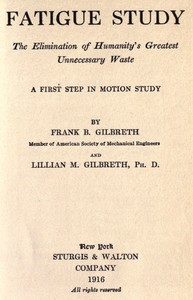
Fatigue study : the elimination of humanity's greatest unnecessary waste.…
First published in 1916, 'Fatigue Study' isn't a story with characters in the traditional sense. The main 'character' is fatigue itself—the universal feeling of being drained. Lillian Gilbreth, alongside her husband Frank, was a pioneer in what we now call ergonomics and time management. This book is her report from the front lines of early 20th-century workplaces and homes.
The Story
Gilbreth acts like a scientific detective. She goes into factories, offices, and homes with a stopwatch and a keen eye, watching how people do everyday tasks. She maps their movements, looking for the pointless steps, the awkward reaches, and the bad lighting that add up to wasted energy. The 'plot' follows her process of observation, measurement, and redesign. She shows how something as simple as rearranging tools on a workbench, improving chair posture, or even changing the height of a sink can cut fatigue in half. The conflict is humanity versus its own inefficient habits, and Gilbreth is offering us the tools to win.
Why You Should Read It
What blew me away was how relevant it feels. We might not be working on assembly lines, but we're drowning in digital clutter, bad chairs, and multitasking that leaves us fried. Gilbreth's core idea—that we should design our surroundings to serve us, not exhaust us—is a game-changer. Reading her careful, almost gentle breakdown of human motion is humbling. She isn't blaming the tired worker; she's critiquing the thoughtless design that made them tired. It reframes exhaustion from a personal failing to a solvable design problem. You'll start noticing your own 'fatigue leaks' everywhere.
Final Verdict
This is for the curious, the perpetually busy, and anyone interested in the hidden systems of everyday life. It's perfect for productivity nerds, history lovers who enjoy seeing how people solved problems a century ago, and anyone who has muttered, 'I'm so tired,' at the end of a seemingly normal day. Don't expect a breezy modern self-help book; it's a methodical, fascinating blueprint from one of history's great practical minds. It might just help you redesign your day and save your energy for the good stuff.
This digital edition is based on a public domain text. Enjoy reading and sharing without restrictions.
Richard Perez
1 year agoAmazing book.
Michelle Taylor
1 year agoThe layout is very easy on the eyes.
Ethan Smith
1 year agoFinally a version with clear text and no errors.
Emma Lewis
1 year agoAfter finishing this book, the content flows smoothly from one chapter to the next. I couldn't put it down.


Emily White
5 months agoAs a long-time follower of this subject matter, the transition between theoretical knowledge and practical application is seamless. Definitely a five-star contribution to the field.