
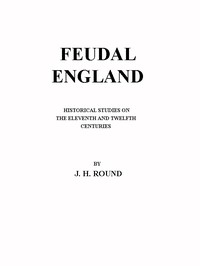
Feudal England: Historical Studies on the Eleventh and Twelfth Centuries by Round
Let's be clear: 'Feudal England' is not a narrative history. Don't open it expecting a sweeping tale of knights and castles. Think of it instead as a series of brilliant, connected investigative essays. John Horace Round, writing in the late 1800s, was a historian with a lawyer's mind and a debunker's spirit.
The Story
There isn't a single plot, but there is a central mission: to correct the historical record. Round focuses on the 11th and 12th centuries, the turbulent period right after the Norman Conquest. Using the Domesday Book—that massive survey ordered by William the Conqueror—as his primary evidence, he dissects how land was actually distributed and held. He challenges the popular idea of a ready-made 'feudal system' brought over from Normandy. Instead, he paints a picture of a power grab. He argues that the classic knight's fee (a parcel of land granted for military service) was largely created after the conquest, as the Norman barons scrambled to secure their control and the king sought to organize his new kingdom's defenses. It's a story of administrative invention, legal cunning, and raw political force, told through charters, rolls, and tax records.
Why You Should Read It
You should read it for the sheer thrill of watching a master at work. Round's writing is sharp, confident, and often polemical. He doesn't just present facts; he builds a case. Reading him dismantle long-held theories feels like watching a seasoned detective solve a cold case. He makes you care about the technicalities of tenure and scutage (a tax paid in lieu of military service) because he shows how these dry details were the weapons and tools of real power. You come away understanding that history is built not just on battlefields, but in ledgers and legal disputes. It’s a powerful reminder that the past is always being rewritten.
Final Verdict
This book is perfect for history buffs who already have a basic timeline of medieval England and want to go deeper. It's for the reader who enjoys authors like Dan Jones or Helen Castor but is ready to look at the scaffolding behind their stories. It's also a fantastic pick for anyone interested in how history itself is made—how scholars interpret evidence and challenge myths. Be warned: it demands your attention. But if you give it, you'll be rewarded with a completely new perspective on the foundations of English society. It’s a challenging, opinionated, and utterly fascinating classic.
This publication is available for unrestricted use. Preserving history for future generations.
David Jackson
1 year agoI've gone through the entire material twice now, and the evidence-based approach makes it a very credible source of information. Top-tier content that deserves more recognition.
Christopher Garcia
10 months agoOne of the most comprehensive guides I've read this year.
Barbara Garcia
6 months agoThe digital index is well-organized, making research much faster.
Emily Moore
7 months agoI've been looking for a reliable source on this topic, and the way it challenges the status quo is both daring and well-supported. A perfect balance of theory and practical advice.




Kimberly Hernandez
1 month agoI stumbled upon this title during my weekend research and the chapter on advanced strategies offers insights I haven't seen elsewhere. A rare gem in a sea of mediocre content.