
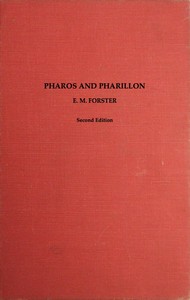
Pharos and Pharillon by E. M. Forster
Let's clear something up right away: Pharos and Pharillon isn't a novel. If you're hoping for a plot about English tourists falling in love in Italy, you'll need to look elsewhere. This is E.M. Forster in essayist mode, but don't let that scare you off. The book is split into two parts. 'Pharos' deals with ancient Alexandria—its birth, its legendary Library, and the clash of ideas that happened there. 'Pharillon' jumps forward to the city's later life under various rulers, capturing moments that feel strangely modern.
The Story
There isn't a single narrative thread. Instead, Forster acts as your guide through Alexandria's long, layered history. He starts with its mythical founding by Alexander and builds the city's story through a collection of sketches. You'll meet figures like the poet Cavafy in his dusty apartment, and learn about the city's famous lighthouse (the Pharos, which gives the book its name). He writes about religious riots, intellectual debates, and the simple, enduring life of the city's streets. The 'story' is the life of the city itself—how it absorbed Greek philosophy, Roman power, Christian faith, and Muslim culture, becoming something entirely unique.
Why You Should Read It
You should read this because Forster makes history feel immediate and personal. He's not just listing dates and battles. He's showing you how people thought, argued, and lived. His prose is sharp, often funny, and full of quiet insight. He has a novelist's eye for the telling detail—the smell of a room, the tone of a conversation—that makes the past snap into focus. Reading this book is like having a brilliant, slightly eccentric friend walk you through a museum, pointing out all the fascinating things you would have missed. You come away not just knowing more about Alexandria, but feeling its chaotic, creative energy.
Final Verdict
This book is perfect for curious readers who enjoy smart, accessible non-fiction. It's a great pick for fans of Forster's novels who want to see another side of his talent. History buffs will appreciate the fresh perspective, but you definitely don't need a degree to enjoy it. It's also ideal for travelers, armchair or otherwise, who love books that capture the soul of a place. At its heart, Pharos and Pharillon is for anyone who believes that places have memories, and that the best stories are often the true ones, told by a master.
Legal analysis indicates this work is in the public domain. You can copy, modify, and distribute it freely.
David Thomas
2 months agoVery satisfied with the depth of this material.
Edward Wright
1 year agoA bit long but worth it.
Jennifer Young
2 years agoRecommended.
Charles Smith
1 year agoCitation worthy content.






Susan Thompson
4 months agoIt’s rare to find such a well-structured narrative nowadays, the way the author breaks down the core concepts is remarkably clear. I'm glad I chose this over the other alternatives.