
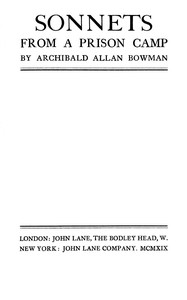
Sonnets from a prison camp by Archibald Allan Bowman
The Story
This book isn’t action-packed. But it’s more gripping than any thriller. Archibald Allan Bowman, a philosophy professor from Scotland, served as a soldier in WWI. Germans captured him in 1918. For the next seven months, he lived in an officer’s prison camp—a mix of crumbling barracks, cold mud, and endless waiting. No dramatic escapes. No heroics. Just day after day of trying not to go crazy. Bowman filled his isolation by writing sonnets, tiny 14-line poems, in secret on scraps of paper. The poems capture everything: the bickering with fellow prisoners, the ache for letters from home, the absurd rules from guards, the silent fear of never being free again. Some poems are dark, others surprisingly funny. One moment he’s describing a stolen cheese sandwich as a feast, the next he’s picturing his family’s empty chairs back in Scotland. The ‘plot’ is simply: can a person stay human when everything says they’re now just a body behind barbed wire?
Why You Should Read It
Because it’s real. Most war books are written years later, romanticized. Bowman wrote these in the middle of all that. You can feel the cramped space inside him—not just in the camp, but in his own head. His poems show how he clings to tiny joys: a kind guard’s smile, the scent of wet grass, the memory of a childhood hill. It’s vulnerable and super brave. The theme that hit me hardest? What happens if you stop hoping? Bowman doesn’t sugarcoat it. Some days the sonnets are sad and tired. But they never stop trying. That matters. This book will make you appreciate Wi-Fi and your own front door more than you ever thought possible. It’s also funny in odd moments. He mocks the monotony by writing an ode to a louse. Who does that? He does. That mix, pretending your worst moment is a joke to survive—that’s peak human strength.
Final Verdict
Perfect for poetry newbies, history geeks, and anyone who’s ever felt stuck. Plus, if you loved The Great Escape but wanted more inner life, grab this. It’s not for readers wanting pure adrenaline. But for quiet rebels who like stories about holding onto your self no matter what? Bowman’s your guy. Think of these sonnets as a slow hug—at first it feels odd, then warm, then kind of powerful.”
This digital edition is based on a public domain text. Distribute this work to help spread literacy.
David Miller
1 year agoLooking at the bibliography alone, the data points used to support the main thesis are quite robust. A refreshing and intellectually stimulating read.
Elizabeth Jackson
11 months agoI've been looking for a reliable source on this topic, and the structural organization allows for quick referencing of key points. This adds significant depth to my understanding of the field.
Robert Jackson
3 months agoWhile browsing through various academic sources, the concise summaries at the end of each section are a lifesaver. It’s hard to find this much value in a single source these days.






David Lee
6 months agoI took detailed notes while reading through the chapters and it addresses the common misconceptions in a very professional manner. It cleared up a lot of the confusion I had previously.