
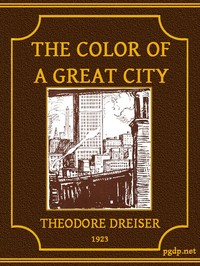
The Color of a Great City by Theodore Dreiser
Theodore Dreiser, famous for his big, heavy novels like Sister Carrie, takes a different approach here. The Color of a Great City isn't a single story with a plot. Think of it as a series of vivid, sometimes gritty, snapshots of New York City in the early 20th century. He wanders through different neighborhoods, from the wealthy avenues to the crowded immigrant quarters. He describes the pushcart vendors, the children playing in the streets, the gloom of the factories, and the frantic energy of the docks. Each chapter is a little portrait of a place, a person, or a moment that, together, builds a complete picture of urban life.
Why You Should Read It
This book surprised me. I expected something dry, but it's incredibly alive. Dreiser has this reporter's eye for detail that makes you feel like you're there. You can almost smell the street food and hear the clatter of the elevated trains. What really got me was his compassion. He doesn't just observe poverty or struggle; he tries to understand the people living it. He shows you the dignity and the drama in everyday scenes. The 'color' in the title isn't just about visual beauty—it's about the emotional texture of the city, the mix of hope, despair, ambition, and weariness. It’s a reminder that a city's soul isn't in its skyline, but in its sidewalks.
Final Verdict
This isn't a book for someone looking for a fast-paced thriller. It's for the wanderers, the people-watchers, and anyone who loves urban history. If you enjoy authors who make a setting feel like a character, like Dickens with London or Didion with Los Angeles, you'll appreciate Dreiser's New York. It's also a fantastic, human-scale companion to all those grand histories of the Gilded Age. Perfect for a slow afternoon, one chapter at a time, letting the atmosphere sink in. You'll finish it and look at your own city with new, more curious eyes.
This work has been identified as being free of known copyright restrictions. Feel free to use it for personal or commercial purposes.
John Lopez
3 months agoThe analytical framework presented is both innovative and robust.
Mary Miller
9 months agoAs a professional in this niche, the way it challenges the status quo is both daring and well-supported. I’ll definitely be revisiting some of these chapters again soon.
Margaret Perez
5 months agoIt’s rare to find such a well-structured narrative nowadays, the concise summaries at the end of each section are a lifesaver. I'm glad I chose this over the other alternatives.
Nancy Lee
1 year agoPerfect.








Karen Thompson
11 months agoI found the author's tone to be very professional yet accessible, the attention to detail regarding the core terminology is flawless. It definitely lives up to the reputation of the publisher.