
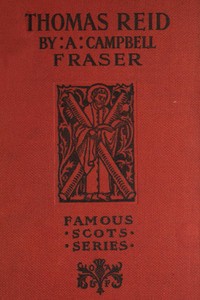
Thomas Reid by Alexander Campbell Fraser
Let's be honest, the title Thomas Reid by Alexander Campbell Fraser doesn't exactly scream 'page-turner.' But trust me, this biography from the late 1800s has more quiet drama than you'd expect. Fraser, writing not long after Reid's time, gives us a clear window into an 18th-century intellectual showdown.
The Story
This isn't a novel with a plot, but it has a clear conflict. The story follows Thomas Reid, a Scottish philosopher living in the shadow of giants like David Hume. Hume's ideas suggested that we can't really be sure of anything outside our own minds—a philosophy that can make the solid world feel pretty shaky. Reid, a practical man and a minister, found this deeply troubling. Fraser walks us through Reid's life and work, showing how he didn't just disagree; he built an entire counter-philosophy he called 'Common Sense.' Reid argued that we are built to believe in an external world, in other minds, and in cause and effect. Our basic intuitions aren't mistakes to be philosophized away; they're the tools we're given to understand reality. Fraser presents this as a respectful but firm battle of ideas, showing Reid carefully taking apart skeptical arguments brick by brick.
Why You Should Read It
I loved this book because it champions the underdog thinker. Reid isn't glamorous, but his ideas feel incredibly sane. In an age where we're told to doubt everything—news, science, even our own eyes—Reid's defense of common sense feels weirdly urgent. Fraser writes with clear admiration, making you root for Reid as he insists that philosophy should explain human life, not make it impossible to live. You get a real sense of the man: principled, thoughtful, and committed to grounding big ideas in everyday experience. It’s a calming antidote to over-intellectualization.
Final Verdict
This is a perfect pick for curious readers who enjoy history or big ideas but don't want a dense textbook. It's especially great if you've ever dabbled in philosophy and found some of it frustratingly detached from real life. Fraser's prose is from another century, so it requires a bit of focus, but his explanation is remarkably clear. You don't need a PhD to follow along. If you're looking for a story about a man who trusted the ground beneath his feet—literally and philosophically—this quiet biography is a rewarding discovery.
This masterpiece is free from copyright limitations. It is available for public use and education.
Margaret Thompson
7 months agoI particularly value the technical accuracy maintained throughout.
Robert Wilson
5 months agoI wanted to compare this perspective with traditional views, the way it challenges the status quo is both daring and well-supported. It cleared up a lot of the confusion I had previously.
Michelle Harris
7 months agoHelped me clear up some confusion on the topic.
David Garcia
11 months agoI stumbled upon this title and it challenges the reader's perspective in an intellectual way. I will read more from this author.
Donald Perez
4 months agoAs a professional in this niche, the case studies and practical examples provided add immense value. If you want to master this topic, start right here.