
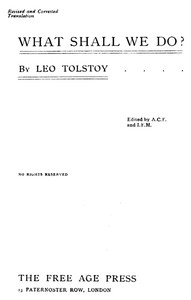
What Shall We Do? by graf Leo Tolstoy
Let's be clear from the start: this is not War and Peace. You won't find epic battles or intricate love stories here. 'What Shall We Do?' is Tolstoy turning his fierce gaze inward, and onto the society around him. It starts in the 1880s. Tolstoy, now a celebrated literary giant, moves his family to Moscow. For the first time, he's confronted daily with the extreme poverty of the city's slums. The experience shatters him.
The Story
The 'story' is really a journey of conscience. Tolstoy describes his growing horror at the inequality he sees. He volunteers at a census, hoping to understand the poor, but realizes he's just a wealthy tourist in their suffering. This sparks a spiritual and intellectual earthquake. He questions the very foundation of his life: his property, his royalties, his privileged existence. He argues that the rich live off the labor of the poor, creating a system of 'organized violence.' The book is his attempt to think his way out of this trap, exploring ideas of Christian anarchism, non-violence, and simple living. It's less a plotted narrative and more a real-time record of a man trying to find a moral compass in a world he sees as profoundly unjust.
Why You Should Read It
What grabbed me wasn't the philosophy, but the painful honesty. This is Tolstoy at his most vulnerable. He doesn't have the answers, and he doesn't pretend to. You feel his guilt, his confusion, and his desperate need to make his life mean something beyond just writing books. Reading it today, it cuts deep. We still live in a world of shocking inequality. His question—'What shall we do?'—echoes every time we scroll past a news headline about a crisis or walk past someone in need. It's a mirror held up to our own compromises.
Final Verdict
This book is perfect for anyone feeling that modern sense of 'ethical whiplash'—the disconnect between our values and our daily lives. It's for the reader who enjoys deep, challenging nonfiction, memoirs of personal crisis, or the roots of activist thought. Don't read it for a tidy solution; Tolstoy never found one. Read it to join a brilliant, troubled mind on its most urgent quest. It's frustrating, illuminating, and, in its own ragged way, deeply inspiring. A powerful reminder that the biggest questions are often the simplest ones.
There are no legal restrictions on this material. It is available for public use and education.
Paul Rodriguez
1 year agoThis was exactly the kind of deep dive I was searching for, the way it handles controversial points with balance is quite professional. I'm glad I chose this over the other alternatives.
Linda Brown
6 months agoThe citations provided are a goldmine for further academic study.
Susan Lopez
11 months agoHaving read the author's previous works, the case studies and practical examples provided add immense value. A refreshing and intellectually stimulating read.
Robert Miller
1 year agoGreat value and very well written.
William Brown
8 months agoI've gone through the entire material twice now, and the author clearly has a deep mastery of the subject matter. I'll be recommending this to my students and colleagues alike.