
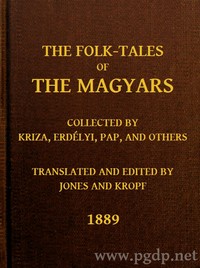
The Folk-Tales of the Magyars Collected by Kriza, Erdélyi, Pap, and Others — Reading Notes

(0 User reviews)   1797
In Category - Folklore
Jones, W. Henry [Editor], Erdélyi, János, 1814-1868 [Contributor], Kriza, János, 1811-1875 [Contributor], Pap, Gyula, 1843-1931 [Contributor], Kropf, Lajos, 1852- [Editor] Project Gutenberg 2013 Not confirmed
Tales -- Hungary; Folklore -- Hungary Readers of public-domain and historical texts
Project Gutenberg digital edition en

Edition facts

Words 186,872
Reading time 813 min
Text sections 26

The catalog record for The Folk-Tales of the Magyars Collected by Kriza, Erdélyi, Pap, and Others — Reading Notes provides practical reading context through 186,872 words, 13 hr 33 min estimated reading time, and 26 detected text sections.

The text analysis averages about 20.9 words per sentence, while the detected sections provide another way to judge how the source is divided.

Project Gutenberg metadata also associates the work with “Tales -- Hungary,” connecting these edition facts with the source record’s subject description.

Explore this collection

Compare your next read

These alternatives are selected using recorded categories and estimated reading time.

Search stored excerpts and compare books → Choose by your preferences →

How these choices and excerpts are prepared

Choices use stored catalog measurements. Estimates vary with reading speed. A shared category is a catalog label, not a claim that two books have the same argument or literary quality.

Search reads excerpt text stored with this catalog and links to its associated Gutenberg record. The connection is stored in the site database; this tool does not recheck that every excerpt is word-for-word identical to that external record. Excerpt search does not cover every chapter and does not verify historical publication dates.

Catalog snapshot checked: 2026-09-26. Coverage: 91 public books, 91 available source excerpts.

This 1889 collection presents Magyar folk-tales in a deliberately literal translation, preserving the oral storyteller's pacing, repetitions, and voice. The editors' comparative notes and the tales' recurring motifs—talking horses, magical eggs, and dragon battles—offer a window into Hungarian narrative traditions.
Share
Editorial Edition Score 4.9/5

Calculated from edition completeness, EPUB availability, text structure and catalogue metadata. Not a user rating.

How this score is calculated
  • Description quality20 pts
  • Title & short description10 pts
  • Source metadata20 pts
  • Text length15 pts
  • Chapters / structure15 pts
  • EPUB file integrity20 pts

Total of 100 points, scaled to a 2.5-5.0 range. Editions with an empty description or a missing EPUB file are not scored.

Edition quality

Public-domain source text

Read the source text

The source text is kept in the dedicated reader, separate from this catalogue record and its commentary.

The editors of this 1889 volume, W. Henry Jones and Lewis L. Kropf, state in their preface that they worked “often till dawn to make the translation as literal as possible,” aiming to preserve the Magyar storyteller’s method and manner. The result is a collection where the narrative voice retains a distinctive oral rhythm—repetitions, direct address, and a matter-of-fact tone that treats magical events as ordinary. In one tale, a Tátos horse speaks matter-of-factly to its master, and the story proceeds without authorial surprise. This fidelity to the source gives the reader a sense of hearing the tale as it might have been told in a Hungarian village.

Oral Cadence and Repetition

The translation preserves the storyteller’s habit of repeating key phrases and actions, a feature that builds suspense and reinforces motifs. In the excerpt about Ambrose and his Tátos horse, the horse’s instructions are given in a series of direct commands: “Plug up my other nostril, too!” The boy’s hesitation is described with the same phrasing used earlier. Such repetition is not a flaw but a deliberate echo of oral performance, where redundancy aids memory and emphasis. The editors’ choice to keep these patterns intact—rather than smoothing them into literary prose—allows the reader to experience the tale’s original pacing.

The Tátos Horse as Narrative Engine

The Tátos horse, a magical creature with five legs and three heads, drives the plot through dialogue and prophecy. It speaks in long, reasoned speeches, explaining how to cure the king’s toothache and predicting the fate of the brothers. The horse’s voice is confident and commanding: “I heard you when you were bargaining,” it tells Ambrose. This speaking animal is not a mere helper but an active agent that shapes events. The tale’s pace quickens when the horse neighs “so loudly that the whole world rang with the sound,” a hyperbolic detail that marks a shift from domestic worry to epic action.

Transformation and the Unheroic Hero

Ambrose begins as a weeping thirteen-year-old, afraid to ask his father for permission to fight dragons. His transformation is physical and symbolic: the Tátos horse blows on him, making him “mangy like a diseased sucking pig,” while the horse itself becomes “golden hair, and glistened like a mirror.” This inversion—the hero appears ugly while his steed shines—subverts expectations. The tale’s voice treats the change without comment, as if such reversals are natural. The boy’s sadness at his own appearance is noted, but the narrative moves quickly to the next action, maintaining a brisk pace that contrasts with the earlier, slower scenes of bargaining and weeping.

Readers should attend to the comparative notes appended to each tale, which trace parallels across European and Asian traditions. These notes, while scholarly, do not interrupt the stories themselves. The collection rewards those who read aloud, as the oral cadences become more apparent. The tales are best approached not as polished literature but as transcribed performances, where repetition, direct speech, and sudden shifts in pace are features, not flaws.

I keep thinking about how those Magyar tales feel like listening to someone speak—the pauses and repeats almost alive on the page. It reminded me of another quiet pleasure, The Coming of Lugh: A Celtic Wonder-Tale Retold — Edition Insights, which carries that same sense of an old voice, unhurried, offering its story like something remembered rather than written.

There are no reviews for this eBook.

0
0 out of 5 (0 User reviews )

Add a Review

Your Rating *
There are no comments for this eBook.

Reader reflection

How will you remember this book?

Save your reaction, strongest insight, and memorable passage.

Your progress 0 / 10
1

Where are you in your reading?

2

How did the book work for you overall?

3

Would you pass this book on to a friend?

4

How much effort did this book require?

Related eBooks









