About 390 minutes
Where Animals Talk: West African Folk Lore Tales — Key Ideas to Explore
Folklore
89,629 recorded words. 7 minutes difference from this book's estimate.
View Gutenberg source #58900
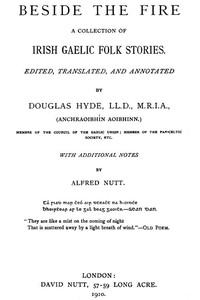
The source record for Beside the Fire: A collection of Irish Gaelic folk stories — Reading Companion measures this digital text at 88,007 words, 6 hr 23 min estimated reading time, and 10 detected text sections.
The text analysis averages about 22.0 words per sentence, while the detected sections provide another way to judge how the source is divided.
Project Gutenberg metadata also associates the work with “Tales -- Ireland,” connecting these edition facts with the source record’s subject description.
Explore this collection
These alternatives are selected using recorded categories and estimated reading time.
About 390 minutes
Folklore
89,629 recorded words. 7 minutes difference from this book's estimate.
View Gutenberg source #58900About 376 minutes
Folklore
86,465 recorded words. 7 minutes difference from this book's estimate.
View Gutenberg source #61730About 375 minutes
Folklore
86,135 recorded words. 8 minutes difference from this book's estimate.
View Gutenberg source #45321Search stored excerpts and compare books → Choose by your preferences →
Choices use stored catalog measurements. Estimates vary with reading speed. A shared category is a catalog label, not a claim that two books have the same argument or literary quality.
Search reads excerpt text stored with this catalog and links to its associated Gutenberg record. The connection is stored in the site database; this tool does not recheck that every excerpt is word-for-word identical to that external record. Excerpt search does not cover every chapter and does not verify historical publication dates.
Catalog snapshot checked: 2026-09-26. Coverage: 91 public books, 91 available source excerpts.
Calculated from edition completeness, EPUB availability, text structure and catalogue metadata. Not a user rating.
Total of 100 points, scaled to a 2.5-5.0 range. Editions with an empty description or a missing EPUB file are not scored.
Public-domain source text
The source text is kept in the dedicated reader, separate from this catalogue record and its commentary.
Douglas Hyde's Beside the Fire (1910) presents Irish Gaelic folk stories with facing English translations, preserving narratives that hedge-schoolmasters and poet-scribes once recited. The volume's dedication honors those 'truly cultured and unselfish men' who kept native lore alive. Alfred Nutt's additional notes frame the tales within Celtic and medieval romance scholarship, as seen in his earlier works listed in the front matter.
The excerpt—a tale of Liam O'Ruanaiḡ—reveals a comic, supernatural plot: a druid creates a double of Liam, who is buried and mourned, only for the real Liam to return and reclaim his wife and pig. The story's humor hinges on mistaken identity and the priest's terrified exorcism, showcasing the blend of everyday life and otherworldly intervention typical of Irish folk tradition.
Hyde prints the Irish Gaelic text alongside his English translation, a format that allows readers to compare the original phrasing. The excerpt uses Irish script (Gaelic type) and includes phonetic details like lenition marks. The narrative voice is colloquial: characters speak in direct, unadorned dialogue, and the plot moves through repeated actions—Liam knocks, the wife refuses entry, the priest commands the pig. This structure mirrors oral storytelling, where formulaic exchanges aid memory and performance. Hyde's introduction notes that these tales were collected from 'the last of the Milesians,' emphasizing their roots in a fading tradition.
In the excerpt, the supernatural appears matter-of-factly: a druid makes a double, a dead man sleeps for a week, and a priest attempts exorcism. The boundary between life and death is porous—Liam's wife accepts his burial as final, yet he returns to claim his property. The pig, a mundane object, becomes the focus of a comic confrontation. This treatment aligns with catalog subjects of Celtic folklore, where fairies, druids, and revenants interact with farmers and priests. Hyde's notes (not excerpted) likely contextualize such motifs within Irish tradition.
The tale reveals social tensions: Liam's wife quickly remarries a servant, and the priest accepts a pig as payment for the wedding. Liam's return disrupts this new order, but the story does not moralize—it ends with the priest fleeing. The humor lies in the wife's pragmatic grief and the priest's cowardice. Hyde's collection, as suggested by the catalog subject 'Tales — Ireland,' likely includes similar stories where cunning and luck trump strict morality. The excerpt offers no clear resolution, leaving readers to infer the outcome from the incomplete text.
Readers should attend to the interplay between Hyde's translations and the original Irish, noting where idioms or humor may shift. The tales reward attention to recurring motifs—trickery, shape-shifting, and the porous boundary between the living and the dead. Nutt's scholarly apparatus, though not excerpted, provides comparative context for those interested in Celtic mythology. This edition preserves a snapshot of Irish oral tradition as it was being transcribed in the early twentieth century.
Reading Hyde’s hedge-schoolmaster’s tale, the dead man’s jesting return felt less eerie than homely—a voice carried on a hearth-wind. It drifted me across the sea, wondering if West African storytellers keep that same patient, laughing grip on the invisible. Where Animals Talk: West African Folk Lore Tales — Key Ideas to Explore brushed past my mind, not as a comparison, but as another fire, another low voice telling the dark to behave itself.
Build a private reading journal entry for this title.









