About 375 minutes
Serbian Folk-lore — Reading Notes
Folklore
86,135 recorded words. 1 minutes difference from this book's estimate.
View Gutenberg source #45321
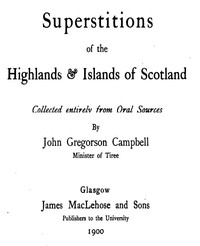
This digital edition of Superstitions of the Highlands & Islands of Scotland Collected Entirely from Oral Sources — Background and Themes is described by source-level measurements including 86,465 words, 6 hr 16 min estimated reading time, and 205 detected text sections.
The text analysis averages about 22.6 words per sentence, while the detected sections provide another way to judge how the source is divided.
Project Gutenberg metadata also associates the work with “Folklore -- Scotland,” connecting these edition facts with the source record’s subject description.
Explore this collection
These alternatives are selected using recorded categories and estimated reading time.
About 375 minutes
Folklore
86,135 recorded words. 1 minutes difference from this book's estimate.
View Gutenberg source #45321About 383 minutes
Folklore
88,007 recorded words. 7 minutes difference from this book's estimate.
View Gutenberg source #60782About 390 minutes
Folklore
89,629 recorded words. 14 minutes difference from this book's estimate.
View Gutenberg source #58900Search stored excerpts and compare books → Choose by your preferences →
Choices use stored catalog measurements. Estimates vary with reading speed. A shared category is a catalog label, not a claim that two books have the same argument or literary quality.
Search reads excerpt text stored with this catalog and links to its associated Gutenberg record. The connection is stored in the site database; this tool does not recheck that every excerpt is word-for-word identical to that external record. Excerpt search does not cover every chapter and does not verify historical publication dates.
Catalog snapshot checked: 2026-09-26. Coverage: 91 public books, 91 available source excerpts.
Calculated from edition completeness, EPUB availability, text structure and catalogue metadata. Not a user rating.
Total of 100 points, scaled to a 2.5-5.0 range. Editions with an empty description or a missing EPUB file are not scored.
Public-domain source text
The source text is kept in the dedicated reader, separate from this catalogue record and its commentary.
John Gregorson Campbell, minister of Tiree from 1861 to 1891, compiled this collection of Highland and Island superstitions solely from oral sources, a method he emphasizes in his preface as essential for accuracy. The work presents localized accounts of supernatural beings, with particular attention to the glaistig or gruagach—a tutelary spirit attached to castles and households. Rather than offering a unified mythology, Campbell's entries reveal striking variation across locations: the glaistig of Dunolly Castle performs household chores like washing and floor-sweeping, while her counterpart at Breacacha Castle in Coll is described as a small figure with white hair who leads strangers astray at night. These differences suggest that belief was shaped by local tradition and geography.
Campbell's insistence on oral sources sets his work apart from earlier compilations that relied on printed accounts. The excerpts show how he records specific place names—Sleat in Skye, the island of Coll, Dunolly Castle, Mearnaig Castle in Glen Sanda—and attaches distinct traits to each location's supernatural resident. At Mearnaig Castle, the only surviving tradition is a call used to rouse an echo: “Are you in, maiden?” (Am bheil thu stigh a mhaighdean?), linking the glaistig to a specific acoustic feature. In Strathglass, the gruagach is never seen but heard at night putting dishes in order, and a shepherd from Morvern experiences a prolonged, mischievous haunting involving missing cheese and a giggling laugh. These localized details demonstrate that Campbell's informants provided concrete, place-bound narratives rather than generic folklore.
The glaistig's behavior oscillates between helpful domesticity and disruptive mischief. At Dunolly Castle, she completes the family washing overnight and protects the castle fool, ensuring his food remains clean. In Coll, she tidies the house before visitors arrive but also leads guests astray at night and maltreats strangers. The Strathglass shepherd's experience includes both annoyance—his jacket disappears, cheese goes missing—and eventual benefit: the glaistig prevents his calves from sucking. This duality suggests that the supernatural being was not purely malevolent or benevolent but responded to human behavior and familiarity. Campbell's accounts preserve these ambiguities without forcing them into a single explanatory framework.
The excerpts reveal material objects and actions used to manage supernatural encounters. The Strathglass shepherd attempts to keep the glaistig away by placing a New Testament above the door and around the walls, indicating the perceived power of Christian texts against such beings. At Sleat, the glaistig's allowance of milk was placed at a specific stone, the Gruagach stone, suggesting a ritualized offering. The description of the Coll glaistig's hair as “like a tuft of flax” (gibeag lìn) ties her appearance to everyday materials. These details ground belief in tangible practices and objects, showing how superstition was interwoven with daily life in the Highlands and Islands.
Campbell's collection offers a valuable record of beliefs that were already fading by the time of his death in 1891. Readers attentive to the geographical and social contexts of each account will notice how the same supernatural figure adapts to different settings—from castle ruins to shepherds' cottages. The work rewards those who read it as a series of local testimonies rather than a systematic treatise, revealing the texture of oral tradition in a specific time and place.
Reading about the glaistigs and gruagachs of Tiree and Skye brought back my grandmother’s stories from Lewis, told in the half-dark of winter evenings. That same feeling of something ancient and half-remembered stirred in me again recently with White Lotus, the legend of the cat's eye — A Reader’s Guide, where folklore weaves itself quietly into the landscape, much like these old voices from the islands. It felt like sitting with her once more.
Answer a few questions and save a private reflection on this device.









