About 24 minutes
The Coming of Lugh: A Celtic Wonder-Tale Retold — Edition Insights
Folklore
5,459 recorded words. 5 minutes difference from this book's estimate.
View Gutenberg source #60859
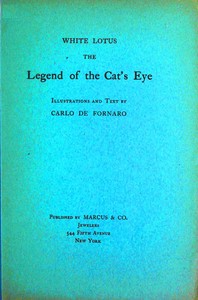
The catalog record for White Lotus, the legend of the cat's eye — A Reader’s Guide provides practical reading context through 4,277 words, 19 min estimated reading time, and 2 detected text sections.
The text analysis averages about 26.1 words per sentence, while the detected sections provide another way to judge how the source is divided.
Project Gutenberg metadata also associates the work with “Gems -- Folklore,” connecting these edition facts with the source record’s subject description.
Explore this collection
These alternatives are selected using recorded categories and estimated reading time.
About 24 minutes
Folklore
5,459 recorded words. 5 minutes difference from this book's estimate.
View Gutenberg source #60859About 33 minutes
Folklore
7,529 recorded words. 14 minutes difference from this book's estimate.
View Gutenberg source #74339About 46 minutes
Folklore
10,527 recorded words. 27 minutes difference from this book's estimate.
View Gutenberg source #65355Search stored excerpts and compare books → Choose by your preferences →
Choices use stored catalog measurements. Estimates vary with reading speed. A shared category is a catalog label, not a claim that two books have the same argument or literary quality.
Search reads excerpt text stored with this catalog and links to its associated Gutenberg record. The connection is stored in the site database; this tool does not recheck that every excerpt is word-for-word identical to that external record. Excerpt search does not cover every chapter and does not verify historical publication dates.
Catalog snapshot checked: 2026-09-26. Coverage: 91 public books, 91 available source excerpts.
Calculated from edition completeness, EPUB availability, text structure and catalogue metadata. Not a user rating.
Total of 100 points, scaled to a 2.5-5.0 range. Editions with an empty description or a missing EPUB file are not scored.
Public-domain source text
The source text is kept in the dedicated reader, separate from this catalogue record and its commentary.
Carlo de Fornaro's White Lotus, the legend of the cat's eye opens with a divine indiscretion: Indra, the great god of the Rig Veda, falls in love with a mortal princess. The narrator immediately signals a tone of playful extravagance, describing the princess's lineage as so blue that 'the sapphire would fade and grow pale,' and her family parchment could stretch across India to Ceylon. This hyperbolic, jewel-inflected language sets the stage for a tale commissioned by Marcus & Co., jewelers of New York, and the text itself becomes a kind of verbal gem—ornate, self-aware, and deliberately precious.
Indra's incarnation as a white Angora cat is the story's central conceit, and Fornaro lavishes description on the transformation: the cat is 'as fluffy and delicate as a cotton puff, immaculately white, with a bushy tail, gray-green eyes, very bristling mustachios and a nose pink as a rose coral bead.' The simile of the coral bead ties the divine cat directly to the gemstone theme that frames the legend. Once adopted into the royal household, the cat named White Lotus receives a daily ritual of offerings: crystal bowls of goldfish, silver bowls of Cashmere goat milk, and a court poet who recites sonnets addressing him as 'O Lord of the Milk! Perfumed Almond Flower! O Little Rajah of the Moon!' The ceremony is both absurd and precise, revealing a world where divine favor is measured in material luxury and poetic flattery.
The court poet's litany of titles for White Lotus deserves close attention. Fornaro lists them in a crescendo: 'Whisper from the Milky Way! Thou Pearl from the Green Sea!' Each epithet draws from natural and celestial imagery—milk, almond, moon, pearl—while maintaining a consistent register of hyperbolic reverence. The poet's 'fervid imagination' is given free rein, and the narrator notes that the titles 'had no limit' but that imagination. This passage functions as a miniature catalogue of the story's own stylistic preferences: it favors accumulation, sensory richness, and a tone that hovers between genuine myth and ironic indulgence. The reader is invited to savor the excess rather than dismiss it.
Published by Marcus & Co., jewelers, the legend carries the imprint of its commercial origin without becoming a mere advertisement. Fornaro's prose is consistently ornate, with sentences that stretch into elaborate clauses—much like the 'parchment' of the princess's lineage that 'would easily have stretched across the peninsula.' The narrator adopts a knowing, slightly amused tone, as when noting that the cat became 'much more important an individual than the Prime Minister or even her own mother.' This wry observation undercuts the grandeur just enough to keep the tale from tipping into solemnity. The result is a voice that feels both scholarly and playful, suited to a legend that is, after all, about a gemstone's origin.
The available excerpts present only the opening of the legend, ending before the cat's eye gemstone is explained. Based on the title and the catalog subject 'Gems -- Folklore,' the narrative likely connects White Lotus's transformation or fate to the formation of the cat's eye stone—a chatoyant gem that resembles a cat's pupil. Fornaro's method is to build a lavish mythological framework around a natural phenomenon, using the god-cat as a bridge between divine caprice and mineralogy. Readers should note that the full text may develop this etiology with further episodes of court intrigue, divine intervention, or metamorphosis. The existing prose, however, already establishes a distinctive voice: one that delights in ornament, ritual, and the marriage of the sacred with the sumptuous.
For readers approaching White Lotus, the key pleasure lies in Fornaro's language—its deliberate excess, its jewel-like similes, and its ability to make a celestial cat's breakfast ceremony feel both absurd and majestic. The legend is brief, but its descriptive density rewards slow reading. Pay attention to how the narrator balances reverence with irony, and how each ornate detail serves the story's ultimate purpose: to explain a gemstone's origin through a tale of divine love and feline grace.
That white Angora cat carrying Indra's quiet longing made me think of another old collection, where every creature moves with a similar gentle strangeness. There is a particular softness in that old Japanese wonder-lore, a sense of worlds brushing against each other without noise. I found myself remembering Japanese Fairy World Stories from the Wonder-Lore of Japan — Background and Themes the same way, like a lamp left on in another room.
Save your reaction, strongest insight, and memorable passage.









