About 205 minutes
Japanese Fairy World Stories from the Wonder-Lore of Japan — Background and Themes
Folklore
46,993 recorded words. 1 minutes difference from this book's estimate.
View Gutenberg source #29337
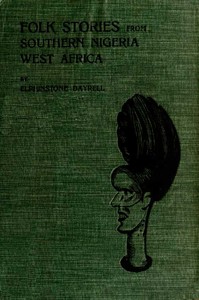
The catalog record for Folk Stories from Southern Nigeria, West Africa — Edition Insights provides practical reading context through 46,830 words, 3 hr 24 min estimated reading time, and 5 detected text sections.
The text analysis averages about 27.8 words per sentence, while the detected sections provide another way to judge how the source is divided.
Project Gutenberg metadata also associates the work with “Tales -- Nigeria, Southern,” connecting these edition facts with the source record’s subject description.
Explore this collection
These alternatives are selected using recorded categories and estimated reading time.
About 205 minutes
Folklore
46,993 recorded words. 1 minutes difference from this book's estimate.
View Gutenberg source #29337About 206 minutes
Folklore
47,258 recorded words. 2 minutes difference from this book's estimate.
View Gutenberg source #55539About 202 minutes
Folklore
46,237 recorded words. 2 minutes difference from this book's estimate.
View Gutenberg source #74064Search stored excerpts and compare books → Choose by your preferences →
Choices use stored catalog measurements. Estimates vary with reading speed. A shared category is a catalog label, not a claim that two books have the same argument or literary quality.
Search reads excerpt text stored with this catalog and links to its associated Gutenberg record. The connection is stored in the site database; this tool does not recheck that every excerpt is word-for-word identical to that external record. Excerpt search does not cover every chapter and does not verify historical publication dates.
Catalog snapshot checked: 2026-09-26. Coverage: 91 public books, 91 available source excerpts.
Calculated from edition completeness, EPUB availability, text structure and catalogue metadata. Not a user rating.
Total of 100 points, scaled to a 2.5-5.0 range. Editions with an empty description or a missing EPUB file are not scored.
Public-domain source text
The source text is kept in the dedicated reader, separate from this catalogue record and its commentary.
The forty tales in this collection, gathered by District Commissioner Elphinstone Dayrell and introduced by Andrew Lang, move through a landscape where animals speak, chiefs hold court, and the boundary between human and non-human is porous. A tortoise outwits an elephant and hippopotamus; a woman made of oil melts in the sun; a disobedient daughter marries a skull. The stories repeatedly turn on questions of obedience, jealousy, and the consequences of broken promises.
Dayrell’s framing as a colonial administrator shapes the record: he presents the tales as “folk stories” from Southern Nigeria, yet the narrative voice often adopts a European fairy-tale cadence. Readers encounter both etiological explanations—why the bat flies by night, why dead people are buried—and trickster plots where the small and clever defeat the large and powerful.
The tortoise appears in multiple tales as a figure who wins through cunning rather than strength. In “How the Tortoise overcame the Elephant and the Hippopotamus,” he challenges both large animals to a tug-of-war, pitting them against each other while he remains uninvolved. The story ends with the tortoise claiming victory, but the narrative does not celebrate his deceit; it simply records the outcome. Elsewhere, the tortoise’s daughter is used as bait to trap a king, and the tortoise himself is sometimes outwitted. The trickster is not a moral hero but a survivor in a world where resources are scarce and power is arbitrary.
Other animals play similar roles. The leopard, the bush cat, and the cock appear as creditors or rivals; the bat is ashamed to be seen by day because of a broken promise. These recurring figures create a consistent moral ecosystem where cleverness is rewarded but also punished when it overreaches.
Many tales explain natural phenomena through failed messages or mistaken commands. In “Why Dead People are Buried,” the Creator sends the dog with a message that the dead should be left in the compound and would revive after twenty-four hours. The dog forgets, eats a bone, and sleeps; the sheep then delivers a garbled version, decreeing burial instead. The story ends with the observation that “if he had not found the bone in the old woman’s house and forgotten his message, the dead people might still be alive.”
Similar patterns appear in “Why the Bat flies by Night,” “Why the Sun and the Moon live in the Sky,” and “Why the Worms live Underneath the Ground.” The explanations are not abstract but rooted in specific failures of communication or obedience. The world as it is—with death, darkness, and hidden creatures—results from a mistake that could have been avoided.
Several stories hinge on physical transformation or vulnerability. The fat woman made of oil melts when forced into the sun by a jealous co-wife; the pretty stranger who kills a king is revealed to be a spirit; the disobedient daughter who marries a skull discovers her husband’s true nature only after it is too late. These bodies are not stable: they can dissolve, reveal hidden selves, or become something other than they seem.
In “The Woman with Two Skins,” a woman sheds her human skin to become a dog, and her husband’s discovery of this secret leads to tragedy. The motif of skin-changing recurs, suggesting that identity is layered and that crossing the boundary between human and animal carries risk. The tales do not moralize explicitly, but the pattern implies that hidden natures will eventually be exposed.
The stories frequently shift settings from the human compound to the wild margins. The hippopotamus and his seven wives retreat to the river after a feast; the leopard’s wife is taken by a fish, explaining why fish live in water; the elephant and the bush cow become enemies after a dispute over territory. These movements are not merely scenic but structural: crossing from village to forest or from land to water often triggers the central conflict or resolution.
In “The Affair of the Hippopotamus and the Tortoise,” the tortoise tricks the hippopotamus into leaving the river, and the hippopotamus’s subsequent return to the water becomes permanent. The boundary between elements is negotiated through deception or force. Water, in particular, serves as a refuge or a prison, and the tales mark the moment when a character becomes confined to one realm.
Dayrell’s collection preserves a set of narrative patterns that reward attention to repetition and variation. The same animals appear in different roles; the same moral logic—that a forgotten message or a broken taboo has lasting consequences—runs through tales of very different lengths. Readers may find it useful to track how the tortoise’s cunning succeeds or fails depending on the company he keeps, and to notice which explanations for natural phenomena recur across multiple stories.
Build a private reading journal entry for this title.









