About 204 minutes
Folk Stories from Southern Nigeria, West Africa — Edition Insights
Folklore
46,830 recorded words. 2 minutes difference from this book's estimate.
View Gutenberg source #34655
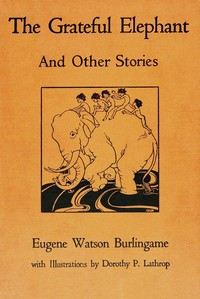
The catalog record for The grateful elephant — Edition Insights provides practical reading context through 46,237 words, 3 hr 22 min estimated reading time, and 37 detected text sections.
The text analysis averages about 17.7 words per sentence, while the detected sections provide another way to judge how the source is divided.
Project Gutenberg metadata also associates the work with “Buddhist legends,” connecting these edition facts with the source record’s subject description.
Explore this collection
These alternatives are selected using recorded categories and estimated reading time.
About 204 minutes
Folklore
46,830 recorded words. 2 minutes difference from this book's estimate.
View Gutenberg source #34655About 205 minutes
Folklore
46,993 recorded words. 3 minutes difference from this book's estimate.
View Gutenberg source #29337About 206 minutes
Folklore
47,258 recorded words. 4 minutes difference from this book's estimate.
View Gutenberg source #55539Search stored excerpts and compare books → Choose by your preferences →
Choices use stored catalog measurements. Estimates vary with reading speed. A shared category is a catalog label, not a claim that two books have the same argument or literary quality.
Search reads excerpt text stored with this catalog and links to its associated Gutenberg record. The connection is stored in the site database; this tool does not recheck that every excerpt is word-for-word identical to that external record. Excerpt search does not cover every chapter and does not verify historical publication dates.
Catalog snapshot checked: 2026-09-26. Coverage: 91 public books, 91 available source excerpts.
Calculated from edition completeness, EPUB availability, text structure and catalogue metadata. Not a user rating.
Total of 100 points, scaled to a 2.5-5.0 range. Editions with an empty description or a missing EPUB file are not scored.
Public-domain source text
The source text is kept in the dedicated reader, separate from this catalogue record and its commentary.
The twenty-six stories in this collection are drawn from the Jātaka, a body of Pāli literature recounting the previous lives of the Buddha. Eugene Watson Burlingame selected them from his earlier work Buddhist Parables (1922), aiming for a “close, idiomatic rendering” that preserves the original’s structure while softening a few phrases. The result is a text that moves between direct speech, formulaic openings (“On a certain occasion the Teacher addressed the monks as follows”), and abrupt moral conclusions. Readers will notice a recurring pattern: a present-day incident prompts the Buddha to tell a past-life tale, which ends with a terse lesson. The stories are not simply fables; they are embedded in a monastic frame that gives each anecdote doctrinal weight.
Every story in this volume begins with a situational cue: “On a certain occasion the Teacher addressed the monks as follows.” This formula establishes the Buddha as the narrator, linking each tale to a specific teaching moment. In the excerpt from “King and Boar,” for instance, the Buddha uses a mango tree that turned sour through contact with nimbs to illustrate how “contact with the corrupt is a bad thing.” The frame does more than introduce the tale; it supplies the interpretive lens. The past-life narrative is always a demonstration of a moral or spiritual principle, and the closing line—often a single sentence like “Evil communications corrupt good manners”—drives the point home. This structure means the stories are never told for their own sake; they are evidence in a sermon.
The well-known parable of the blind men and the elephant appears here in a version that emphasizes repetitive phrasing and cumulative detail. The king’s servant lets each blind man feel a different part—head, ears, tusks, trunk, belly, legs, back, tail—and each time says, “This, O blind men, is what an elephant is like.” The blind men then report their findings in matching parallel clauses: “Your majesty, an elephant is like a water-pot,” “like a winnowing-basket,” “like a plow-share,” and so on. The repetition builds to a physical fight, after which the king is “delighted.” The Buddha’s application extends the metaphor: heretics, “blind, without eyes,” quarrel in the same way. The excerpt shows how Burlingame’s translation preserves the oral, incantatory quality of the original Pāli, with its balanced clauses and incremental listing.
The stories in this collection end with startling economy. After the narrative concludes, the Buddha often delivers a single line that encapsulates the lesson. In “The Grateful Elephant,” the title story, the moral is “Where there’s a will, there’s a way.” In “Grateful Animals and Ungrateful Man,” it is “Driftwood is worth more than some men.” These proverbs are not elaborated; they stand as the final word. The effect is to compress complex narratives into memorable aphorisms. The reader is left to connect the tale to the tag, a process that requires attention to the story’s details. The brevity also reflects the oral tradition: the moral is a mnemonic hook. Burlingame’s translation does not expand or explain; it lets the stark juxtaposition of story and saying carry the weight.
Because these stories are selected from a larger work, they lack the connective tissue of the original commentary. Readers who encounter a tale that seems abruptly introduced or concluded should remember that each is a fragment of a longer discourse. The illustrations by Dorothy Lathrop, mentioned in the front matter, are not reproduced here; the text alone must carry the narrative. Pay attention to the repeated formulas—they are not redundancy but structure. The stories reward slow reading, especially aloud, where their rhythmic patterns become audible.
Reading the Jātakas, I remembered my grandfather’s slow voice, the same unhurried patience when he once quietly explained an old Cornish folktale to me by candlelight. Stories of animals learning gratitude felt less like lessons then, more like shared secrets. That feeling returned while leafing through Cornwall's Wonderland — Reading Companion, its gentle familiarity almost a whispered echo.
Answer a few questions and save a private reflection on this device.









