About 401 minutes
Household Stories by the Brothers Grimm — A Reader’s Guide
Fairy Tales
92,025 recorded words. 3 minutes difference from this book's estimate.
View Gutenberg source #19068
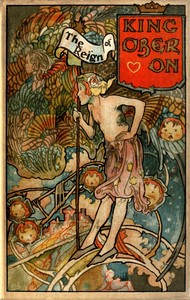
The reign of King Oberon — Background and Themes can be approached with a clearer sense of reading commitment from its source measurements: 92,747 words, 6 hr 44 min estimated reading time, and 61 detected text sections.
The text analysis averages about 26.8 words per sentence, while the detected sections provide another way to judge how the source is divided.
Project Gutenberg metadata also associates the work with “Fairy tales,” connecting these edition facts with the source record’s subject description.
Explore this collection
These alternatives are selected using recorded categories and estimated reading time.
About 401 minutes
Fairy Tales
92,025 recorded words. 3 minutes difference from this book's estimate.
View Gutenberg source #19068About 372 minutes
Fairy Tales
85,543 recorded words. 32 minutes difference from this book's estimate.
View Gutenberg source #38070About 332 minutes
Fairy Tales
76,156 recorded words. 72 minutes difference from this book's estimate.
View Gutenberg source #36540Search stored excerpts and compare books → Choose by your preferences →
Choices use stored catalog measurements. Estimates vary with reading speed. A shared category is a catalog label, not a claim that two books have the same argument or literary quality.
Search reads excerpt text stored with this catalog and links to its associated Gutenberg record. The connection is stored in the site database; this tool does not recheck that every excerpt is word-for-word identical to that external record. Excerpt search does not cover every chapter and does not verify historical publication dates.
Catalog snapshot checked: 2026-09-26. Coverage: 91 public books, 91 available source excerpts.
Calculated from edition completeness, EPUB availability, text structure and catalogue metadata. Not a user rating.
Total of 100 points, scaled to a 2.5-5.0 range. Editions with an empty description or a missing EPUB file are not scored.
Public-domain source text
The source text is kept in the dedicated reader, separate from this catalogue record and its commentary.
Walter Jerrold's The Reign of King Oberon (1902) presents itself not as a random gathering of fairy tales but as a curated volume from the 'Annals of Fairyland,' a framing device that gives the collection a mock-historical coherence. The preface addresses 'My Dear Young Folks' and names previous volumes in the series—The Reign of King Herla and The Reign of King Cole—while acknowledging that many stories have been told before by Andersen, Grimm, Perrault, and others. This editorial note examines how the catalog subject 'Fairy Tales' interacts with the actual texture of the excerpts, which reveal a voice more sardonic and structurally self-aware than the generic label might suggest.
The preface establishes a conceit: the stories were 'first told at the Court of King Oberon' and later recorded in the Annals. Jerrold lists his sources—Ben Jonson, Thomas Hood, Douglas Jerrold, Sir George Dasent—as if citing authorities for a historical document. This mock-scholarly apparatus is unusual for a children's book of the period and suggests that the collection is as much about the tradition of fairy-tale telling as it is about the tales themselves. The dedication poem, in which the narrator watches Titania's court and feels 'heights unknown to thought,' reinforces the idea that the volume mediates between the fairy world and the reader, positioning the editor as a privileged observer rather than a mere compiler.
The extended excerpt from 'Princess Rosette' departs markedly from the decorous tone often associated with fairy-tale collections. The princess is described as 'an ugly creature' and 'as wicked as she is ugly'; the peacocks cry 'Fie, fie, how ugly she is!' instead of the expected salute. The King's reaction—'he very nearly died on the spot' and 'tore his clothes'—is played for broad comedy. The narrative voice is blunt: 'A nice wife for our King; well, we are not surprised!' This sardonic commentary, combined with the physical humor of boxed ears and blown fists, suggests that Jerrold's retellings lean toward the ironic and the grotesque, qualities that align more with the literary fairy-tale tradition of Perrault than with the sentimental Victorian fairy tale.
The excerpt from 'Princess Rosette' centers on a deception plot: the nurse and boatman have substituted an ugly, violent girl for the true princess. The King imprisons the brothers and threatens execution, while the impostor behaves 'as if she were already mistress of all and everything.' This pattern of mistaken identity, unjust punishment, and eventual revelation is a staple of fairy tales, but Jerrold's version emphasizes the cruelty of the court's reaction—the brothers are thrown into a 'dark cellar, full of horrible reptiles'—and the impostor's gratuitous violence. The excerpt breaks off before resolution, but the tone suggests that the tale will not shy away from harsh consequences. This recurring motif of deception leading to severe punishment appears in other stories in the collection, such as 'Rumpel-Stilts-Ken' and 'The Goose-Girl,' though the excerpts do not confirm their specific treatment here.
Readers approaching The Reign of King Oberon should expect a collection that wears its learning lightly but with a knowing wink. The framing device of the Annals invites comparison between versions, and the excerpts suggest that Jerrold's retellings are neither sanitized nor reverent. The volume rewards attention to the interplay between the editor's voice and the traditional material, as well as to the illustrations by Charles Robinson, which are not excerpted here but are integral to the 1902 edition.
There’s something gentle about the way old tale collections hold their secrets, isn’t there? I found myself thinking of that after reading The Reign of King Oberon—the sharp, playful cruelty felt oddly tender in hindsight. It reminded me of another book, one that sits quietly on the shelf like a familiar chair. The Fairy Ring — A Reader’s Guide lingered with me the same way, almost like a whispered footnote to a story I thought I knew.
Your answers remain private and are stored only in this browser.